

Reviewed by an Appliance Forever technician
The Appliance Forever Repair Team
TSSA-licensed appliance repair technicians · GTA, York Region & Simcoe County
This guide is written and reviewed by the working technicians on our service trucks — not generalist content writers. The fixes you read here are the same ones we walk through on real same-day service calls across the GTA, every day.
- TSSA-certified — Technical Standards & Safety Authority Gas Technician 2 (mandatory for gas appliances in Ontario)
- WSIB-insured — Workplace Safety & Insurance Board coverage on every visit
- HRAI member — Heating, Refrigeration and Air Conditioning Institute of Canada
- Factory-trained on Samsung, LG, Bosch, Whirlpool, KitchenAid, GE, Maytag and 25+ other major brands
- 15+ years diagnosing error codes across thousands of repairs in Vaughan, Markham, Aurora, Newmarket, Bradford, Barrie and across the GTA
Want this diagnosed in person? Call (647) 834-4646 for same-day service, or book online. We service all of the GTA, York Region and Simcoe County.
Most Ontario homeowners treat the microwave like the friendliest appliance in the kitchen — push a button, get hot food, repeat. So when it starts buzzing strangely, sparking inside, or heating unevenly, it’s tempting to keep using it “for now.”
That “for now” is where most of the real damage starts.
In our 365-day-a-year service work across Toronto, Vaughan, Markham, Richmond Hill, Barrie, and the rest of our service area, the same pattern shows up again and again: a small, cheap fix gets ignored, and three months later the same customer is calling about an electrical fire, a melted control board, or a fridge of leftovers that made the family sick. Microwaves aren’t simple — they’re high-voltage appliances with one of the most powerful capacitors in your home — and ignoring early symptoms is genuinely risky.
Here’s what’s actually at stake when you put off a microwave repair, and how to know when it’s time to stop using it.
Why a “Small” Microwave Problem Isn’t Small
A microwave isn’t a kettle. Inside the casing, a high-voltage transformer steps your standard 120V wall current up to several thousand volts of DC and feeds it into a magnetron — a vacuum tube that generates electromagnetic waves at 2,450 MHz to heat your food. That high-voltage capacitor stays charged after you unplug the unit, sometimes for days, which is why microwave repair is one of the very few appliance repairs we never recommend doing yourself.
Three things go wrong when symptoms get ignored:
- The high-voltage components have no margin for error — a small short becomes a fire fast.
- The door’s radiation-blocking “choke” depends on millimetre-precise alignment.
- A failing magnetron leaves cold spots in your food that bacteria love.
We’ll walk through each one below.
The 5 Real Dangers of Ignoring Microwave Repairs
1. Fire and Electrical Failure
Cooking is the leading cause of residential fires in Ontario. The Office of the Fire Marshal’s investigation of structure fires found cooking accounted for roughly 18% of ignition sources where a documented loss occurred — outpacing electrical wiring (9%) and heating systems (8%). Microwaves show up in those reports more often than people expect.
The two most common ignition paths inside a microwave are:
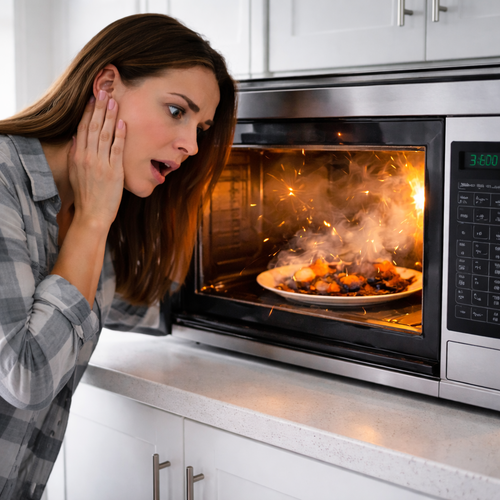
- Waveguide carbonization. The waveguide cover — that small mica or polymer panel inside the cavity — gets coated with grease and food splatter. Over time it carbonizes. Carbon conducts electricity, so when the magnetron fires, you get arcing (those bright flashes and sharp crackling sounds). Keep using it and the grease ignites.
- Cooling fan failure. The magnetron runs hot. If the internal cooling fan starts grinding or humming oddly and you ignore it, the magnetron overheats, the wiring insulation melts, and you get a short directly to the chassis.
The Electrical Safety Authority’s most recent Ontario Electrical Safety Report tracks a long-term 40% increase in non-workplace electrical fatalities over the past decade — meaning home electrical fires are getting more common, not less. A buzzing, sparking, or hot-smelling microwave is a real warning, not a quirk.
If your microwave catches fire: keep the door closed (oxygen feeds the fire), unplug it only if you can do so safely, and call 911 if it doesn’t self-extinguish. Don’t open the door to “blow it out” — that creates a backdraft.
2. Electric Shock — The High-Voltage Capacitor Problem
This one is specific to microwaves and it’s why we won’t talk a customer through a DIY microwave repair on the phone the way we sometimes do for a dishwasher or dryer.
The high-voltage capacitor inside your microwave can hold a lethal charge long after the unit is unplugged. Removing the casing, touching the wrong terminal, or trying to bypass a “stuck” door switch you saw on YouTube can cause severe injury or death. There is no warning, no spark you can see — just contact and arrest.
A licensed appliance technician carries an insulated discharge tool and follows a specific sequence to bleed that charge before any internal work begins. Skip that step and the capacitor doesn’t care how careful you are.
3. Radiation Leakage Through a Damaged Door
Microwaves use non-ionizing radiation — they don’t make food radioactive, and a healthy unit poses no exposure risk. Once it powers down, the energy is gone. Health Canada is clear on this.
What changes that calculation is a damaged door.
Under the federal Radiation Emitting Devices (RED) Act, every microwave sold in Canada must keep leakage below 1 mW/cm² at 5 cm from the surface during normal operation — a limit Health Canada sets at roughly ten times below any threshold associated with biological harm. Sealed door + intact “choke” = no measurable risk.
But the door is the weakest part of the appliance, and it fails in predictable ways:
- Slamming the door warps the hinges and shifts the choke geometry.
- Hardened grease around the seal stops it from sitting flush.
- Hairline cracks in the perforated metal screen on the front window break the Faraday cage that keeps energy contained.
- A bent frame can make the redundant safety interlocks misalign.
If your door is hard to close, sticks, has visible cracks, or doesn’t sit flush — stop using the microwave until it’s been inspected. Health Canada gives the same advice. We service door assemblies on every brand we work with, including Samsung, LG, Whirlpool, Bosch, GE Appliances, KitchenAid, Panasonic, Sharp, and Maytag.
4. Food Poisoning From Uneven Heating
This one rarely makes the list, and it should.
Microwaves cook unevenly by design. The 2,450 MHz waves bounce around the cavity creating standing-wave patterns — high-energy hotspots and low-energy cold spots. The rotating turntable and internal mode stirrer exist specifically to move food through those patterns so the cooking averages out.
When the turntable motor fails (a $90–$140 fix, one of the most common microwave repairs we do), the food sits in one place. The cold spots stay cold. And when the magnetron itself is degrading with age — every microwave loses output as it ages — the package instructions on the box stop being accurate. “Two minutes on high” becomes “two minutes that left the centre at 35°C, which is right inside the danger zone.”
Health Canada defines that danger zone as 4°C to 60°C — temperatures where bacteria like E. coli, Salmonella, and Listeria multiply rapidly. Reheating leftovers in a weakening microwave is the single most common way Ontario households end up with food poisoning from a meal that “looked fine.”
The fix is usually cheap. The risk is real.
5. Hidden Hydro Costs (Especially in Ontario)
A failing microwave doesn’t just cook badly — it costs more to run.
A unit with a leaky door seal, a dying magnetron, or a worn cooling system needs longer cycles to do the same work. Studies on degraded units suggest 15–25% more electricity for the same heating job. That’s not catastrophic on its own — but Ontario’s electricity pricing structure makes it sting.
If you’re on the Ultra-Low Overnight (ULO) rate plan (the option many GTA households moved onto in 2023–2025), the on-peak weekday window from 4 p.m. to 9 p.m. is priced at 39.1¢ per kWh for the November 2025–April 2026 period set by the Ontario Energy Board. That’s the most expensive electricity in the province, and it’s the exact window most families use the microwave for dinner.
You’re paying premium rates for cycles that take 25% longer than they should. And that extra runtime accelerates wear on the high-voltage components, which makes the next repair bigger than the one you skipped.
Warning Signs Your Microwave Needs Service Now
If you notice any of these, stop running the unit until a technician has looked at it:
- Sparking, arcing, or flashes inside the cavity — even brief ones
- Loud buzzing or humming without heat being produced
- Burning smell during or after operation
- Door that sticks, doesn’t sit flush, or has visible cracks in the seal or window screen
- Food heats unevenly or stays cold in the centre after a normal cycle
- Control panel ghosting — buttons firing on their own or unresponsive
- Cooling fan grinding or staying on long after the cycle ends
- Microwave runs with the door open (this is a critical safety failure — call us the same day)
The reviews left by our customers in Vaughan, Bradford, Markham, and across the GTA include several “the microwave randomly lost power” and “stove and microwave both stopped” calls — these almost always trace back to one of the symptoms above being ignored for weeks.
Common Faults by Brand
Different brands fail in different ways. After fixing thousands of units across the GTA, York Region, and Simcoe County, here’s what we see most often:
- Samsung / LG over-the-range microwaves: keypad and membrane switch failures, vent fan motor wear, “SE” or “5E” sensor errors.
- Whirlpool / KitchenAid / Maytag: door switch interlock failures, magnetron weakness around year 6–8.
- Bosch built-in microwaves: control board faults, common in the integrated combi-oven units popular in King City, Aurora, and luxury Richmond Hill homes.
- GE Appliances / Panasonic / Sharp countertop units: capacitor and high-voltage diode failure (loud humming with no heat).
- Miele, Thermador, Viking, JennAir: premium built-in units where repair almost always beats replacement on cost — these are $1,500–$4,000 appliances.
If you’re seeing a specific error code, our error codes library covers the most common ones.
Repair vs. Replace — The Honest Math
The general rule technicians use is the 50% rule: if a repair costs more than half the price of a comparable new unit, replace it.
But that rule has to be read alongside the appliance’s age and where it’s mounted.
Typical microwave repair costs in the GTA (CAD, 2026):
| Fault | Typical cost | Worth fixing? |
|---|---|---|
| Door switch / interlock | $80–$130 | Almost always yes |
| Internal fuse | $80–$120 | Yes |
| Turntable motor | $90–$140 | Yes — fixes cold-spot food safety issue |
| High-voltage diode or capacitor | $80–$200 | Depends on age — strong yes for built-ins |
| Magnetron replacement | $100–$300 | Yes for over-the-range and built-in; rarely worth it on a $150 countertop unit |
| Touch pad / control board | $190–$250+ | Marginal — usually only on premium units |
| Door/frame assembly | $200–$500 | Replace the appliance instead |
A $400 repair on a $1,200 built-in Bosch with five years of life left is excellent value. The same $400 on an 8-year-old countertop unit you bought at Costco for $180 isn’t.
Two things people forget when deciding:
- Built-in and over-the-range microwaves are expensive to replace — not just the unit ($500–$1,200) but the install ($150–$400 by a licensed installer) and the cabinetry rework if the new model has different dimensions.
- Throwing out a working appliance has an environmental cost. Microwaves contain lead, cadmium, and flame-retardant plastics — they’re banned from regular curbside garbage in Ontario under the RPRA’s WEEE program. If you do replace, drop the old unit at a Toronto/York Region environment day or a Best Buy/Staples take-back depot, not the curb.
What to Do Right Now if Your Microwave Is Acting Up
- Stop using it for cooking food if you’re seeing sparks, smelling burning, or the door isn’t sealing.
- Unplug it. If it’s an over-the-range or built-in unit and the plug isn’t accessible, switch off the breaker.
- Don’t open the casing. The capacitor risk isn’t worth the fifteen minutes you’d save.
- Note the model and serial number (usually on the door frame or inside the cavity).
- Check it against Health Canada’s recall database — recalls on microwave-style units have happened recently and you may be eligible for a free fix.
- Book a diagnostic. Request service online or call 647-834-4646 — we’ll usually have a technician at your door the same day or next day across the GTA, York Region, and Simcoe County.
Our diagnostic fee is transparent and credited toward the repair if you proceed. No hidden charges, no upselling, no “we’ll have to come back next week” — our technicians carry common parts on the truck and finish most jobs the first visit.
Frequently Asked Questions
Is it safe to use a microwave with a slightly damaged door?
No. Even small misalignments in the door frame, hinges, or perforated screen can break the radiation-containing “choke” geometry that keeps microwave energy inside the cavity. Stop using it and book an inspection. Most door-related repairs are completed in one visit.
My microwave hums but doesn’t heat — what’s wrong?
The most likely culprits are the high-voltage diode, the capacitor, or the magnetron. All three are repairs that should only be done by a technician because of the capacitor’s stored charge. The repair is generally $100–$300 and worth doing on most over-the-range or built-in units.
Why is my microwave sparking inside?
Three usual causes: a metal object accidentally placed inside, a damaged waveguide cover saturated with grease, or a failing component arcing internally. Stop the cycle immediately, unplug the unit, and have it inspected. Continued operation is a real fire risk.
Are microwaves more expensive to run when they’re failing?
Yes. A degraded unit can use 15–25% more electricity for the same heating result. In Ontario, where on-peak rates can hit roughly 39¢ per kWh between 4 p.m. and 9 p.m., that adds up — especially because microwave dinner-time use lines up exactly with peak pricing.
How long should a microwave last?
Most countertop microwaves last 7–10 years. Built-in and over-the-range units, properly serviced, can run 12–15 years. The biggest factor is door discipline (don’t slam it) and keeping the interior clean so the waveguide cover doesn’t carbonize.
Can I fix my microwave myself?
Almost every other appliance repair has a safe DIY tier. Microwaves don’t. The high-voltage capacitor can hold a lethal charge for days after unplugging, and bypassing a faulty door interlock can cause radiation leakage. Even experienced electricians who don’t work on appliances regularly defer to appliance technicians for microwave work.
Do you service my city?
Yes — we cover the full GTA, York Region, and Simcoe County, including Vaughan, Markham, Richmond Hill, Aurora, Newmarket, Barrie, Bradford, Innisfil, Georgina, North York, East York, Concord, Maple, Woodbridge, King City, Holland Landing, and East Gwillimbury. 365 days a year, including weekends and holidays.
Don’t Wait Until It’s a Fire
A buzzing, sparking, or unevenly-heating microwave isn’t an inconvenience — it’s the earliest signal that one of the highest-voltage appliances in your home is starting to fail. The cheapest moment to fix it is right now, before the failure cascades into the magnetron, the wiring, or the cabinetry above it.
If you’re seeing any of the warning signs in this article:
📞 Call or text 647-834-4646 for same-day service
🔧 Request service online — 24/7 booking
📍 Family-owned. TSSA-licensed. WSIB-insured. Operating 365 days a year across the GTA, York Region & Simcoe County.
Sources & Further Reading
- Electrical Safety Authority — Ontario Electrical Safety Report (most recent edition): esasafe.com
- Office of the Fire Marshal & Emergency Management Ontario — Cooking fire statistics
- Health Canada — Microwave Ovens and Radiation: canada.ca
- Ontario Energy Board — Time-of-Use and ULO rates (Nov 2025–Apr 2026): oeb.ca
- Government of Canada — Radiation Emitting Devices Act
- Resource Productivity and Recovery Authority (RPRA) — WEEE program: rpra.ca
Related Articles
- Why Overloading the Dishwasher Causes Repairs
- The Importance of Professional Stove Inspections
- Refrigerator Not Cooling Properly — Diagnose and Fix Common Issues
- DIY Microwave Repair — Safe Basic Checks (safety-only — most microwave issues need a technician)