

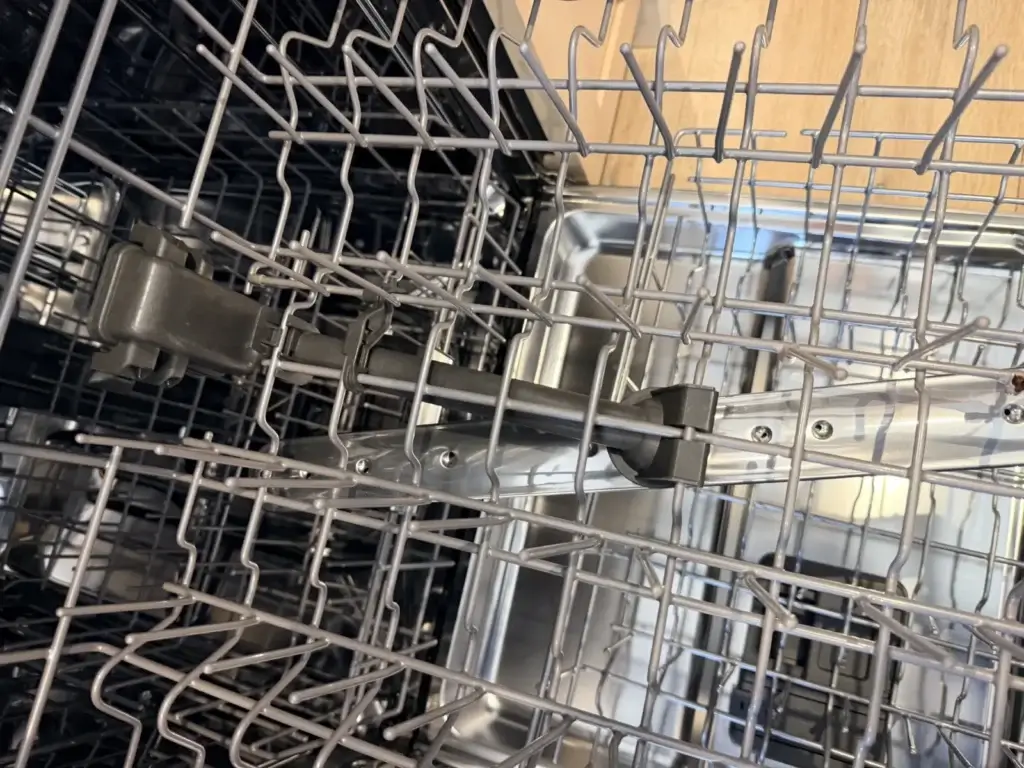
3-second answer: If your Frigidaire dishwasher won’t drain at the end of the cycle, the cause is almost always one of two things: a clogged cylindrical filter at the bottom of the tub (most owners never clean it and it eventually packs solid with food scraps and grease), or a kinked or food-clogged drain hose behind the disposal or sink. Both are 15-minute DIY fixes. If the filter and hose are clear and the dishwasher still leaves standing water, the problem is the drain pump itself — a real repair job we cover below.
In this guide
The 6 most common causes of a Frigidaire dishwasher that won’t drain
Frigidaire dishwashers — across the Gallery, Professional, Crown, and Universal lines — share the same drain architecture: filter assembly on the floor of the tub → drain pump (impeller plus motor) → check valve → outlet hose → either the under-sink air gap, the high loop, or the garbage-disposal inlet. A blockage at any one of those points stops the cycle from emptying. Here are the six causes in the order you should rule them out.
1. Clogged cylindrical filter assembly
This is the #1 cause by a wide margin — roughly 85% of “won’t drain” calls we run in the GTA come down to this. Frigidaire moved away from self-cleaning macerator filters around 2014 in favour of a serviceable cylindrical filter that the owner is supposed to clean once a month. Most owners never read that line in the manual. Over months, the mesh packs with rice, lentil skins, fruit pulp, label paper, and rendered grease — water can’t physically pass through. The dishwasher pumps, hits the obstruction, and either errors out or sits with a tub full of dirty water at the end of the cycle.
How to spot it: Pull the lower rack, look at the centre of the tub floor. If you see a circular plastic cap with arrows showing a quarter-turn, that’s the filter. Lift it out — if it’s brown, slimy, or has visible food packed against the mesh, you’ve found your cause.
2. Kinked or food-clogged drain hose
The drain hose runs from the back of the dishwasher up to a “high loop” under the sink (or through an air gap), then down to the disposal or sink drain. Two things go wrong: (a) installation kinks where the hose bends sharply against the cabinet wall — common after appliance moves, kitchen renovations, or installer shortcuts — and (b) food particles that made it past the filter settling at the lowest point of the loop and gradually narrowing the bore until water can’t flow.
How to spot it: Pull the dishwasher forward 30cm, look at the back. Hose visibly kinked or pinched? That’s your problem. Squeeze the hose along its length — soft spots mean a soft clog inside.
3. Garbage-disposal knockout plug or air-gap blockage
If your dishwasher drains into a garbage disposal that was installed AFTER the dishwasher, there’s a 50/50 chance the installer forgot to knock out the dishwasher drain plug inside the disposal inlet. That plug is a factory-installed piece of plastic that physically blocks the dishwasher hose from draining into the disposal. Dishwasher pumps water out, water hits the plug, water comes back. Same outcome with a clogged air gap on the counter.
How to spot it: Brand-new “won’t drain” symptom right after a disposal install — knockout plug. Water spitting from the air-gap fitting on the counter during a cycle — air gap is plugged.
4. Drain pump failure
The drain pump is a small impeller motor mounted on the underside of the tub. It runs for ~90 seconds at the end of every wash cycle. The two failure modes: impeller jammed (a piece of broken glass, a fruit-sticker, or a hairpin found its way past the filter and is now wrapped around the impeller shaft) or motor windings open (worn out — typical after 7-10 years of daily use).
How to spot it: No drain sound at all from under the dishwasher during what should be the drain phase, or a brief electrical hum followed by silence. Filter is clean. Hose is clear.
5. Check valve stuck closed
The check valve is a one-way flap on the drain-pump outlet that prevents drained water from sucking back into the tub. If it gets gunked up with grease or a small piece of debris jams it closed, water tries to drain, hits the stuck flap, can’t go anywhere, and slowly settles back into the tub.
How to spot it: Pump audibly runs (you hear the impeller spinning) but no water moves out. Often paired with a soft sloshing sound right after the cycle ends — that’s water sneaking back past a partially-stuck flap.
6. Control-board fault (least common)
The control board sends the “run drain pump” signal at the right moment in the cycle. If the relay on the board that switches the drain pump has failed — usually from age or a power-supply spike — the pump never gets the signal and the cycle ends with water in the tub. This is genuinely uncommon (under 5% of cases) but it’s what’s left after you’ve eliminated everything else.
How to spot it: Manual diagnostic test (we cover the button sequence below) won’t fire the drain pump even though the pump tests good on the bench. Or: random alphanumeric error codes that don’t fit any single fault pattern.
Frigidaire drain error codes — what they mean
If your dishwasher’s display is showing a code while the wash light blinks, jot it down before you start working — it narrows the cause significantly. Codes vary by line (older Crown and Universal models flash via the wash-cycle indicator lights; newer Gallery and Professional models show alphanumeric codes), but the drain-related ones are:
- i20 / iC0 — drain motor circuit issue. The control board can’t see the drain pump on its expected circuit. Either the pump is dead, the wiring harness is loose at the pump connector, or the relay on the board failed. About two-thirds of i20/iC0 codes resolve with a filter+hose clean (the pump was actually fine but couldn’t move water, which the board reads as a fault).
- i30 — water level / leak detected at base. Not a direct drain code, but commonly fires when a stuck check valve lets water sit in the base pan and the float sensor trips. Clean the base, dry the float, run a cycle.
- iF0 — turbidity sensor fault. The optical sensor that gauges water cloudiness is reading bad data. Often caused by greasy buildup on the sensor lens after filter neglect — same root cause as the drain problem itself.
- “Er” plus a fast-blinking wash light (older Crown / Universal): Pre-2018 models used a blink-code system. Count the blinks: 6 blinks = drain fault, 8 blinks = pump motor fault. Reset by holding START/CANCEL for 3 seconds, then run a Rinse-Only cycle.
For Bosch owners reading along, the equivalent fault is Bosch’s E24 drain code. Samsung’s leak/drain code is LC (guide), and LG’s is AE (guide) — same family of root causes, different sensor wiring.
The 5-step DIY fix
Set aside 20 minutes, a flat-head screwdriver, a turkey baster (or measuring cup) plus a towel, and a flashlight. Work in this order — each step rules out one of the top causes in sequence.
Step 1 — Cut power and remove standing water
Before you put a hand in the tub: flip the breaker for the dishwasher circuit, or unplug it at the access panel under the sink. Open the door. Use the turkey baster to lift the standing water out of the tub bottom into a bowl (or push a towel down and squeeze it into the sink). Don’t skip this — you need a dry working area to inspect the filter properly, and you don’t want a 120V relay closing on a flooded compartment.
Step 2 — Clean the cylindrical filter
Pull the lower rack out. In the centre of the tub floor you’ll see a circular plastic cap, usually 3-4 inches across, with arrows molded into the top. Twist a quarter-turn counter-clockwise and lift straight up — the upper “fine” filter comes out as one piece. Underneath sits the lower “coarse” filter (a flatter mesh basket); lift that out too. Take both to the sink, rinse under hot tap water, and scrub the mesh with an old toothbrush. You’re looking for the mesh to be visibly clean and water to pass freely through it. Reinstall: coarse filter down first, cylindrical filter on top with the arrows aligned, twist clockwise to lock.
Step 3 — Check the garbage-disposal connection and the air gap
If your dishwasher drains into a disposal: pull the dishwasher’s drain hose off the disposal’s inlet nipple. Shine a flashlight into the nipple from the outside. See a flat plastic disc inside? That’s the knockout plug — pop it out with a screwdriver and hammer (it falls into the disposal; run the disposal to grind it). If you have an air gap (the chrome dome on the counter beside the faucet), pop the top off, lift the inner cap, and clear any food debris with a paperclip.
Step 4 — Inspect the drain hose
Pull the dishwasher forward 30cm — just enough to see behind it without disconnecting anything. Look at the corrugated drain hose. Two things to find: (a) kinks where it bends against the cabinet — straighten and re-secure with a small zip-tie or hose clamp so it stays straight; (b) clog at the lowest point of the hose — disconnect it at the disposal or air-gap end, lift the loose end above the dishwasher level, and pour a cup of hot water into it. Water should flow back out the open end freely. If it doesn’t, run a kitchen snake through the hose or replace it (~$25 at any hardware store).
Step 5 — Run a short cycle and watch the drain
Reconnect power. Don’t load anything yet. Start the Rinse-Only cycle (Quick Wash on Universal-line models). At minute ~5 you should hear the drain pump fire — a steady hum for 60-90 seconds with water audibly flowing into the disposal or sink. If you hear that and the tub is dry at the end, you’re done. If the tub is still wet or the pump hums without water moving, jump to the drain-pump section below — you’re in the 5-10% of cases that need parts.
Filter clean, hose clear, and it still won’t drain? That points to the drain pump, check valve, or control board — components that need diagnostic testing and OEM parts. Book a same-day GTA tech: 647-834-4646 (your $89 service-call is applied to the repair if you go ahead).
When the drain pump itself has failed
If you’ve cleared the filter, the hose runs straight, and a multimeter at the pump motor terminals shows continuity but no rotation when energized, the impeller is jammed or the motor windings are open. Drain-pump replacement on a Frigidaire dishwasher is a 45-60 minute job for a technician: tip the unit forward, remove the lower kick-plate, disconnect the inlet and outlet hoses (expect ~1 cup of residual water), unplug the wiring harness, twist-and-pull the old pump out, install the new one (genuine Frigidaire OEM runs $110-180 in parts), reconnect, and test on a dry cycle.
On Crown and Universal models from 2015-2019, the check valve is integrated into the pump housing — a stuck check valve can mimic a failed pump and is replaced as a single unit. On Gallery and Professional models from 2020 forward, the pump is a sealed direct-drive design with a separate inline check valve at the outlet — both can be replaced individually if needed.
If the pump tests fine on the bench but the dishwasher still throws iC0 or a wash-light blink-code, the issue is the control board not sending the run signal — diagnose with a wiring schematic before swapping a $250+ board. We carry the diagnostic charts for every Frigidaire model in the truck.
Frigidaire model-line quick reference
Frigidaire’s dishwasher portfolio in Canada has four broad lines, each with slightly different filter and drain-pump access:
- Universal (FFCD24xxxx, FFBD24xxxx): Entry tier. Self-cleaning macerator on pre-2014 builds; cylindrical filter on 2014-forward. Drain pump accessed from the front kick-plate.
- Gallery (FGID2476xx, FGCD25xxxx): Mid tier. Cylindrical filter standard, larger-bore drain hose, integrated soft-food disposer on some 2021+ builds. Alphanumeric display shows iC0/i20.
- Professional (FPID2495xx, FPHD2491xx): Top tier. Stainless tub, third rack, “PowerWash” jets. Direct-drive sealed drain pump, separate inline check valve. Quietest and the most fault-tolerant of the four lines.
- Crown (FGHD2491xx, FGHD2433xx): Older mid-range (largely 2010-2018). Cylindrical filter; pump+valve integrated unit. Uses wash-light blink codes, not alphanumeric.
If your model number starts with PLD (older Frigidaire badged as Kenmore Elite at some Canadian dealers), the filter is non-self-cleaning — meaning if it’s never been cleaned in 10 years, it’s almost certainly your cause. PLD-series filters lift straight out without a quarter-turn.
Repair vs replace — what it costs in the GTA
Not every Frigidaire dishwasher is worth repairing. Here’s the honest decision matrix based on what we see in GTA, York Region, and Simcoe County homes:
- Filter cleaning or hose unclog: $89 service call → if it’s just filter or hose, that’s the bill. Accounts for roughly 85% of “won’t drain” calls.
- Drain-pump replacement (under 7 years old): $230-310 total (parts plus labour, service-call applied). Worth doing — the drain pump is the heaviest-cycled component, but $230 to extend the life of a $700-1,400 dishwasher is the right math.
- Drain pump plus control board (8-12 years old): $400-550 total. Borderline. Depends on aesthetic condition, whether the door seal is still good, and whether other components are degrading at the same time. We’ll tell you straight if it’s not worth it.
- 12+ years old, multi-component failure: Replace. An entry-level new Frigidaire is roughly $650-800 installed; a mid-range Gallery is $1,100-1,400. Don’t pour money into a unit on borrowed time.
Across our GTA service area, the median Frigidaire-not-draining job in the past year was $267 — well inside repair-makes-sense territory. We quote before any parts work.
How to stop it from happening again
- Clean the filter monthly — not when it stops draining, monthly. Rinse under hot tap water with an old toothbrush. Two-minute job. The single biggest thing you can do.
- Scrape plates before loading. Frigidaire’s “no pre-rinse needed” marketing is true for sauces and soft scraps, but large food chunks still clog the filter mesh over time.
- Run the disposal first if your drain hose tees into it — clears anything sitting in the disposal that could backwash into the dishwasher line.
- Monthly hot-water rinse cycle with no detergent. Flushes grease that builds up inside the drain-pump impeller and the check valve.
- Never wash items with stickers, twist-ties, candy wrappers, or hairpins. Those are the #1 cause of pump-impeller jams.
For more long-life tips, see our guide on why overloading the dishwasher causes repairs, our general DIY dishwasher repair guide, and our breakdown of what those weird dishwasher noises mean.
When to call a GTA pro
Call us if any of these apply:
- You’ve cleaned the filter and hose, and the dishwasher still won’t drain
- iC0, i20, or i30 returns immediately after a reset
- You can hear the drain motor hum but no water moves
- Water leaks from the base when the drain cycle tries to run
- Burning-electrical smell during the drain phase
- The drain phase never starts at all (no pump sound, no display change)
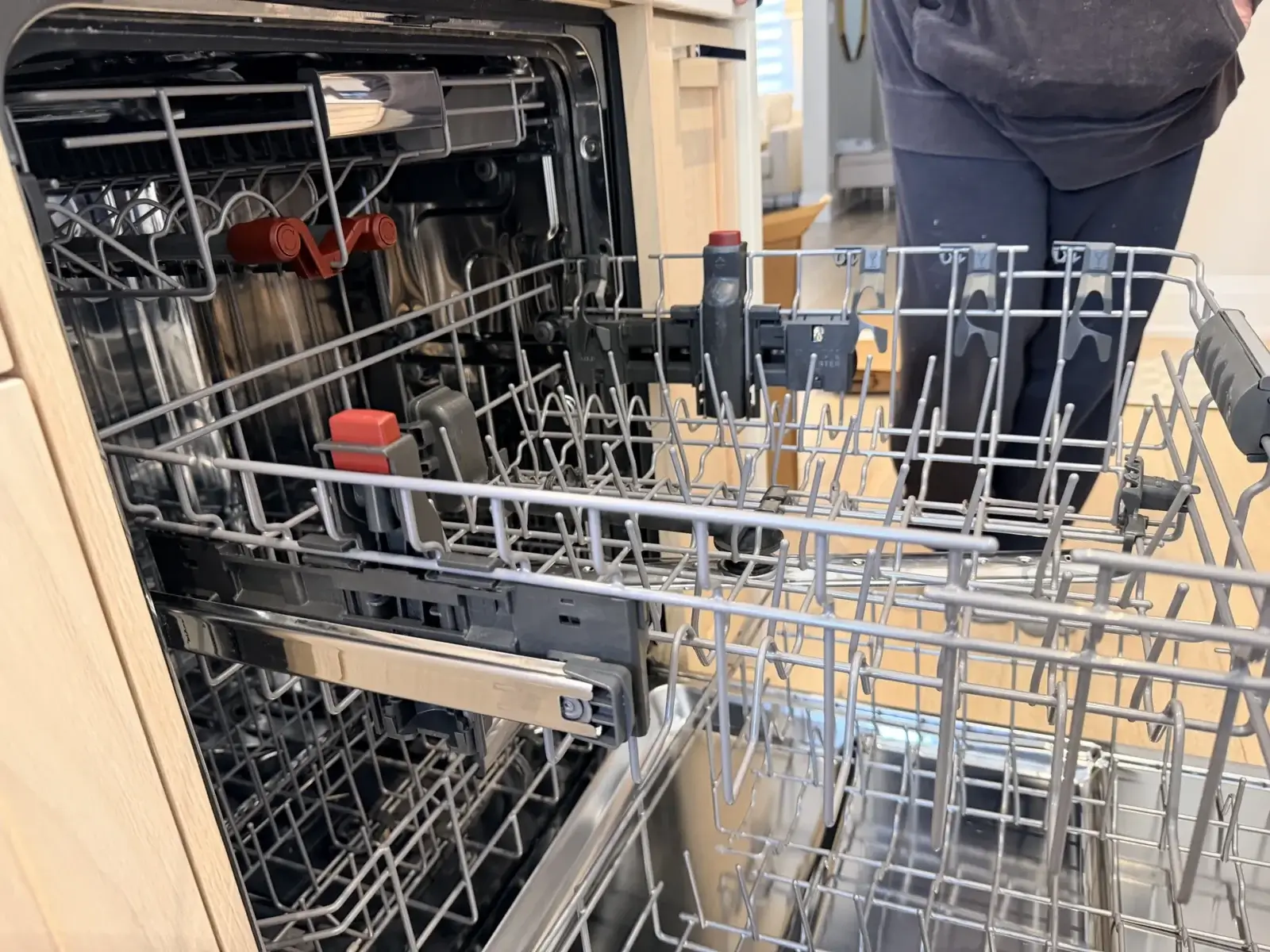
Appliance Forever covers the entire GTA, York Region, and Simcoe County — Vaughan, Markham, Aurora, Newmarket, Bradford, Barrie, Innisfil, Scarborough, North York, Richmond Hill, and beyond. We’re TSSA-certified for gas, factory-trained for Frigidaire and 30+ other brands, and our $89 service call applies to the repair. Book same-day at 647-834-4646 or browse our dishwasher repair services and Frigidaire repair page.
FAQ — 10 quick answers
Why won’t my Frigidaire dishwasher drain at the end of the cycle?
In ~85% of cases it’s a clogged cylindrical filter on the floor of the tub or a kinked drain hose behind the dishwasher. Both are 15-minute DIY fixes. The rest are drain-pump impeller jams, stuck check valves, or control-board faults — and they typically need a tech with diagnostic tools and OEM parts.
How do I clean the filter on a Frigidaire dishwasher?
Pull out the lower rack. Find the circular cap in the centre of the tub floor. Twist it counter-clockwise a quarter-turn and lift straight up — that’s the cylindrical “fine” filter. Lift out the flat “coarse” filter underneath. Rinse both under hot tap water, scrub the mesh with an old toothbrush, then reinstall: coarse first, cylindrical on top, twist clockwise to lock. Repeat once a month.
Where is the drain pump on a Frigidaire dishwasher?
Underneath the tub, accessed by removing the lower kick-plate at the front of the unit. On Universal and Gallery lines it’s a stand-alone unit roughly the size of a fist. On Professional models from 2020 forward, it’s a sealed direct-drive design integrated with the sump. Replacement is a 45-60 minute job.
Can I reset my Frigidaire dishwasher to clear a drain error?
Yes — but a reset alone doesn’t fix the underlying cause; it just clears the code. Hold the START/CANCEL button for 3 seconds (older Crown/Universal) or press the OFF button twice within 3 seconds (Gallery/Professional). If the code returns on the next cycle, you have an actual fault to diagnose — not just a sensor glitch.
How much does it cost to fix a Frigidaire dishwasher that won’t drain?
In the GTA: filter or hose clean ≈ $89 (the service-call rate). Drain-pump replacement ≈ $230-310 total. Control-board replacement ≈ $320-450 total. The median Frigidaire-not-draining job we ran in the past year was $267. We quote before any parts work; the $89 service-call is applied to the repair if you go ahead.
Is it normal to have a little water in the bottom of my Frigidaire dishwasher?
A small amount — under 1cm in the sump area near the filter — is normal between cycles and keeps the seals from drying out. A visible pool of dirty water sitting on the tub floor at the end of a cycle is not normal — that’s a drain problem.
What does the i20 error code mean on a Frigidaire dishwasher?
i20 (and the closely related iC0) means the control board didn’t detect the drain pump operating as expected. Two-thirds of i20 codes resolve with a filter and hose clean — the pump itself was fine but couldn’t move water past the obstruction, which the board read as a fault. If i20 returns after cleaning, the pump, wiring harness, or board itself needs testing.
Should I repair or replace a 10-year-old Frigidaire dishwasher?
It depends on what failed and how. A 10-year-old unit with just a drain-pump failure and good cosmetics is worth repairing ($230-310). A 10-year-old unit with the pump, control board, and a leaky door seal all failing in the same year is replace-territory — pour the repair money toward a new unit. We’ll give you a straight repair-or-replace recommendation on-site.
Why does my Frigidaire dishwasher fill but not drain?
Fill working + drain not working narrows the fault to the drain side specifically: filter, drain hose, disposal connection, air gap, drain pump, or check valve. The inlet valve and float sensor (which control fill) are clearly fine. Work through the 5-step DIY fix above in order.
Do you service Frigidaire dishwashers in the GTA?
Yes — we cover Frigidaire, Gallery, Professional, and Crown lines across the GTA, York Region, and Simcoe County. Same-day appointments in Vaughan, Markham, Aurora, Newmarket, Bradford, Barrie, Innisfil, and Scarborough. Call 647-834-4646 — TSSA-certified, factory-trained, $89 service-call applied to the repair.
Frigidaire dishwasher still won’t drain after the DIY fix?
Book a same-day diagnostic across the GTA, York Region, and Simcoe County. TSSA-certified, factory-trained for Frigidaire — your $89 service call is applied to the repair.
Call now: 647-834-4646